
Jan Mion

Hypnotherapy for Fear of Driving

Get back on the road without planning your route around it.

You can drive — that was never the question. The question is why your body sounds the alarm at the motorway on-ramp, even though you've known that stretch for years.

Book an appointmentOnline across Switzerland

5.05000+ Sessions · 11+ Years

Jan Mion, Hypnotherapist EZC
Jan Mion
Hypnotherapist EZC
Fear of driving isn't about whether you can drive. The fear switches off your inner autopilot and forces you to consciously steer every single move — and that's exactly what makes the drive worse. In hypnotherapy we work on that reaction. Usually two to five sessions, online across Switzerland or in person in Zurich.
  • 2–5 Sessions typically
  • 60 min per session
  • The chair the dreaded drive
  • Online across Switzerland
How it works

How hypnotherapy addresses fear of driving

You learn to drive consciously, then you drive it unconsciously. After a few thousand kilometres, an inner autopilot handles most of it: following distance, checking mirrors, the gas pedal, merging lanes. You decide where you're going — it does the rest.

Fear switches that autopilot off. It decides the automatic part is too risky and pulls everything back into conscious control. Except the conscious mind is far too slow for that job. For many people the drive genuinely gets stiffer and more strained as a result — and the bad drive is then cited as proof the fear was right all along.

Arguments don't get you far here. You already know the road is safe and that you've driven it for years, and it changes nothing. Your unconscious doesn't negotiate over statistics — it reacts to images.

In trance, that's exactly what we work on: the evaluation itself. We downgrade the driving situation back to what it actually is — demanding, yes, threatening, no — and hand the work back to the autopilot that's been doing it better than your conscious mind for years.

Fear of driving doesn't take away your ability to drive. It takes away your autopilot.

In detail

Overcoming fear of driving: what actually happens

Fear of driving ranges from a queasy feeling before the motorway on-ramp to a full panic attack on the hard shoulder. And it doesn't strike the inexperienced. Most people who come to me with this have been driving for twenty or thirty years, have never had an accident — and don't understand themselves why something that was second nature for decades suddenly no longer works.

Fear of driving, or lack of practice?

This distinction comes first because it decides what we're even working on. Lack of practice simply means the experience isn't there yet. Someone who got their licence twelve years ago and has barely driven since doesn't have a fear problem, they have a mileage problem. That gets solved on the road, not in a chair.

Fear of driving is the opposite. You can drive, you've proven it a thousand times over, and the alarm still goes off. The reaction is out of proportion to what's actually happening on the road. That's exactly where hypnotherapy starts: on the reaction, not on your ability.

Where it tips

There are almost always situations that reliably trigger it, and others that stay completely fine. For some it's the motorway and merging lanes; for others it's the tunnel, the bridge, the roundabout, night driving or a tailgater in the mirror.

Some of these triggers have a neighbour. The tunnel is often related to claustrophobia, and for some people a fear of heights sits behind the bridge and the mountain road. That makes a difference for the work, because then we're not driving the motorway, we're driving the tunnel.

The fear supplies its own proof

After a few thousand kilometres, driving runs by itself: following distance, checking mirrors, the gas pedal, changing lanes. Your inner autopilot handles all of it while you're busy with the radio.

Fear switches it off. It decides the automatic part is too risky and pulls every single move back into conscious control. Except the conscious mind is far too slow for that. For many people the drive genuinely gets stiffer, more strained, less precise as a result — and here's the catch: the bad drive is then cited afterward as proof the fear was right. That's how it feeds itself.

When everything comes too fast

Under tension, your sense of time speeds up. The on-ramp comes too soon, the gap is too small, the truck is suddenly right there. In trance we work on exactly this sensation: more time within the same second. Anyone who's experienced that once describes the same road afterward as noticeably wider.

Why it never needed an accident

Very few people can name the moment it started. No crash, no near miss, nothing. That's unsettling in its own way, because it feels like you haven't even honestly earned this problem.

The work doesn't need the trigger. A fear is a learned evaluation, and learned things can change, even without knowing which lesson it got stuck in.

The drive that happens in the chair

The practical part of hypnotherapy: you don't have to drive the dreaded route outside. In trance, you take the on-ramp, merge, drive through the tunnel — while your body stays seated. Your unconscious has the experience anyway.

The real motorway on-ramp won't let you get out. The chair will, any time. For a fear that's about control, that's no small detail. The same mechanism, incidentally, applies to fear of flying — you just aren't the one behind the wheel there.

The result isn't indifference to traffic. What's left is a drive you don't think about again afterward.
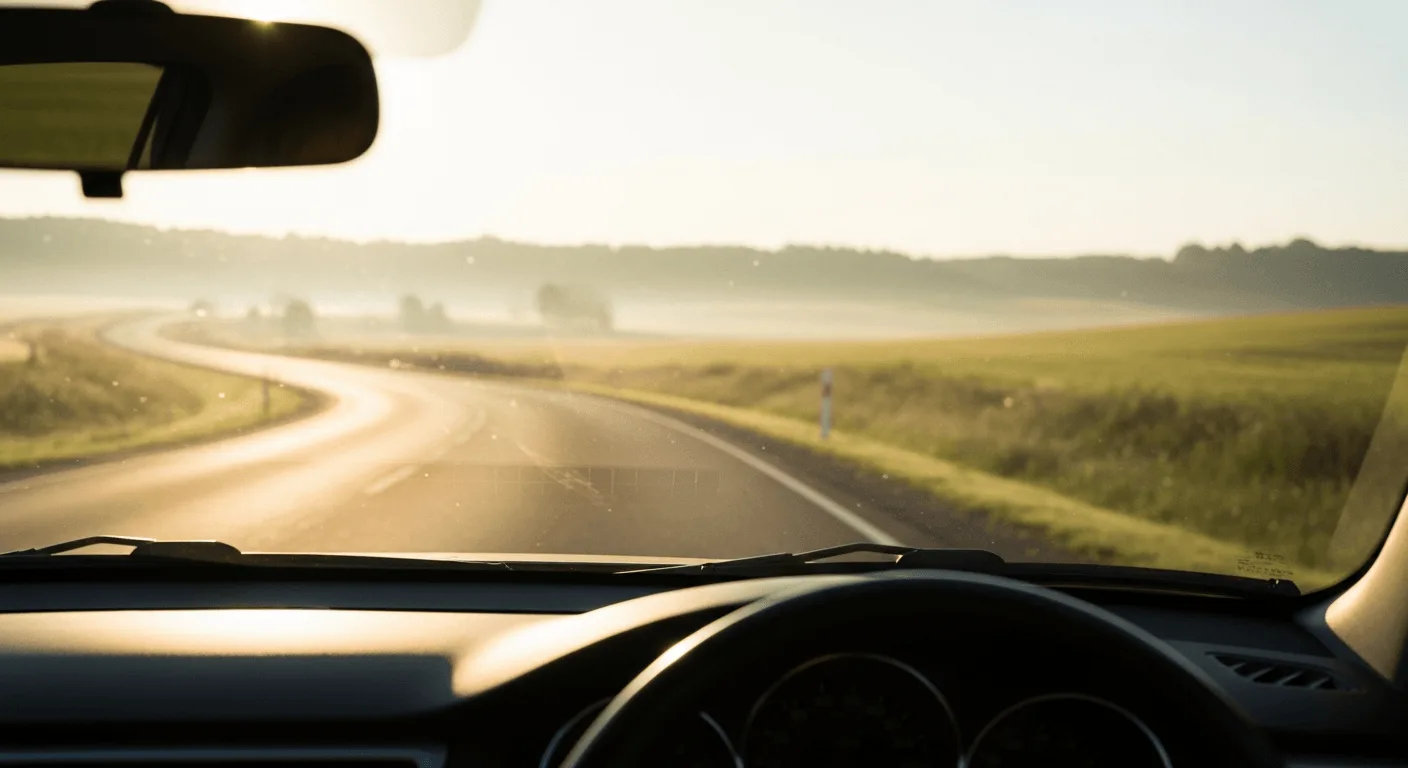
Hypnotherapy for fear of driving: calm at the wheel instead of tension on the motorway
In focus

You drive the dreaded stretch in trance first — your body stays in the chair.

The change

What it's like when a drive is just a drive again

Your attention stays where it belongs: on the road. What goes is the alarm that turns a motorway on-ramp into an event days in advance.

  • The motorway instead of a forty-minute detour on back roads
  • Tunnels, bridges and roundabouts without your pulse spiking beforehand
  • A tailgater in the mirror stays just a tailgater
  • Saying yes to a trip without checking the route first
  • Driving yourself instead of having to ask someone else
Who it's for

Who is this suited for?

Fear of driving doesn't strike the inexperienced. I regularly see people with thirty years behind the wheel who can no longer manage a motorway on-ramp.

  • In certain situations it tips: racing heart, sweaty hands, the sense that everything is coming at you too fast.
  • You take detours, cancel trips or let someone else drive — and never say the real reason.
  • The film runs days beforehand: the merge, the tunnel, everything that could go wrong.
  • You consciously steer every single move and arrive exhausted, even though it was only an hour.

If the panic shows up not only at the wheel but also in shops, on trains and in meeting rooms, the car is just one stage among many — then this isn't where we start.

In a session

What happens in a session

Usually two to five sessions, booked one at a time. How far we drive in any given one is a pace you set with me.

  1. 01
    Where exactly it tips
    First I want to know which situations these are: the on-ramp, the tunnel, the roundabout, stop-and-go traffic, night driving. When it last went well, and what you see in front of you in that moment. Most people can't name a trigger — that's completely normal and doesn't make the work any harder.
  2. 02
    Arriving
    You get comfortable, and I guide you into a calm, focused state. You stay responsive the whole time. On a topic that's about control, that's not a minor detail.
  3. 03
    The drive, in the chair
    Now we take the route you're afraid of: the on-ramp, the merge, the tunnel. In trance, while your body stays seated. In doing so, we reconnect you with the parts that have handled driving automatically for years, and hand the steering back to them.
  4. 04
    Coming back
    I bring you back to full waking awareness, and we look at what's shifted. And what you'll notice first on your next drive.
Online or in person

Hypnotherapy for Fear of Driving — online or in the practice

The work happens in what's going on inside you, not in the car. So the place you sit for it can be the calmest one you can get.

Online by video

A quiet room, a laptop or phone, headphones — that's all it takes. With this topic that has a real advantage: you don't have to get in a car for the appointment itself. Anyone who dreads driving would otherwise already be tense before we've even started.

More about online hypnotherapy

In person in Zurich

Two practices, in Enge and in Hottingen, both a few minutes from the station. Reachable by train, no hunting for parking. And if you'd rather have someone in the same room, that's reason enough.

Serious hypnotherapy

Serious hypnotherapy for fear of driving

What people hear about their fear of driving — and what's actually true.

What you hear

Anyone who no longer trusts themselves behind the wheel just isn't a good driver.

Serious therapy

This fear shows up regularly in people with decades of driving experience. It says nothing about your ability — it just stops you from accessing it.

What you hear

Without an accident, there's no real reason for fear of driving.

Serious therapy

Most people who come to me with this can't name a single moment it started. A trigger isn't a requirement — not for the fear, and not for the work on it.

What you hear

In hypnosis, someone else takes the wheel.

Serious therapy

Nobody takes over anything here. You're awake, you hear me, you can talk and you can stop whenever you want. What you hand over in trance is the tension, not the control.

What you hear

A few sessions and you'll drive through every tunnel without any fear at all.

Serious therapy

That's not how I sell it. Realistically: the panic loses its grip, and what's left is the respect a motorway on-ramp actually deserves.

Will it work for me?

Yes — the question is how long you've been avoiding it.

Hypnotherapy works for almost everyone who engages with it. The question is rarely whether something changes, but at what pace.

Where you land depends more on you than on the topic — I've seen both, with the same concern. With fear of driving, one thing matters most: how many routes you've come to avoid by now, and whether the car is the only place the alarm goes off.

Usually quick
2–3 sessions

It's a clearly defined situation, and otherwise you drive completely normally.

  • only the motorway or only the tunnel
  • been like this for a year or two
  • you still drive daily regardless
The most common case
3–4 sessions

Several situations trigger it, and the detours have long since become a habit.

  • motorway, tunnel and dense traffic all at once
  • you've been planning routes around it for years
  • no trigger you can recall
When more is tied up in it
5 or more

The car is just one of several places the alarm fires too early.

  • panic outside the car too
  • other fears are tied in with it
  • you haven't driven in some time

My honest promise: If after the first session I get the impression we're working on the wrong thing, I'll tell you — instead of selling you a second one.

Jan Mion – hypnotherapist
Your therapist

About Jan Mion

Jan Mion is a hypnotherapist in Zurich. What he keeps encountering with fear of driving isn't the question 'can I still do this' but 'am I even still allowed to'. People rarely doubt their ability — they withhold their own permission to get behind the wheel.

  • Hypnotherapist EZC
  • 1500+ hours of training
  • 5000+ individual sessions
  • In private practice since 2015

With this topic I rarely work on the driving itself. I work on you trusting yourself again with something you've long known how to do.

Investment

Simple, fair pricing

Hypnotherapy session
CHF 200
per session, approx. 60 minutes

CHF 200 per session, about 60 minutes. There's no free initial consultation with me — the first session is already the work, not a getting-to-know-you conversation.

Good to know

Common questions about hypnotherapy for fear of driving

Can hypnosis help with fear of driving?

Yes. The work isn't on the traffic, it's on your reaction to it: the evaluation of the driving situation, the images that already run before you've even started the car, and the tension that takes automatic driving away from you.

How do I get rid of the fear of driving?

In trance, you drive the dreaded route while your body stays in the chair. The fear isn't deleted in the process — you learn a new reaction to the same situation, and over time that becomes the stronger of the two. For you it feels like the old one is simply gone.

Where does fear of driving come from?

Sometimes there's an experience behind it — an accident or a near miss. More often it's an evaluation that settled in gradually. Most people who come to me can't name a single moment — and none is needed for the work either.

Where do panic attacks while driving come from?

Usually from fear of the fear itself. After the first intense reaction at the wheel, you start watching yourself, every faster heartbeat becomes an early warning, and that's exactly what triggers the next attack. That loop is what we work on in hypnotherapy.

What is social fear of driving?

That's what some people call the part of driving fear that's about others: being watched, pressured, judged while parking or at a roundabout. It's not its own diagnosis, but it's a very common trigger.

How many sessions does hypnotherapy for fear of driving take?

Usually two to five. Where you land depends more on you than on the topic — I've seen both, with the same concern.

What does hypnotherapy for fear of driving cost?

A session runs about 60 minutes and costs CHF 200. For the usual range of two to five sessions, budget CHF 400 to CHF 1,000, and each session is booked individually.
Start here

Ready for the first step?

Book the first session, then we'll look at exactly where it tips for you. If it turns out hypnotherapy isn't the right fit here, I'll tell you and we'll leave it at that.

Book an appointment