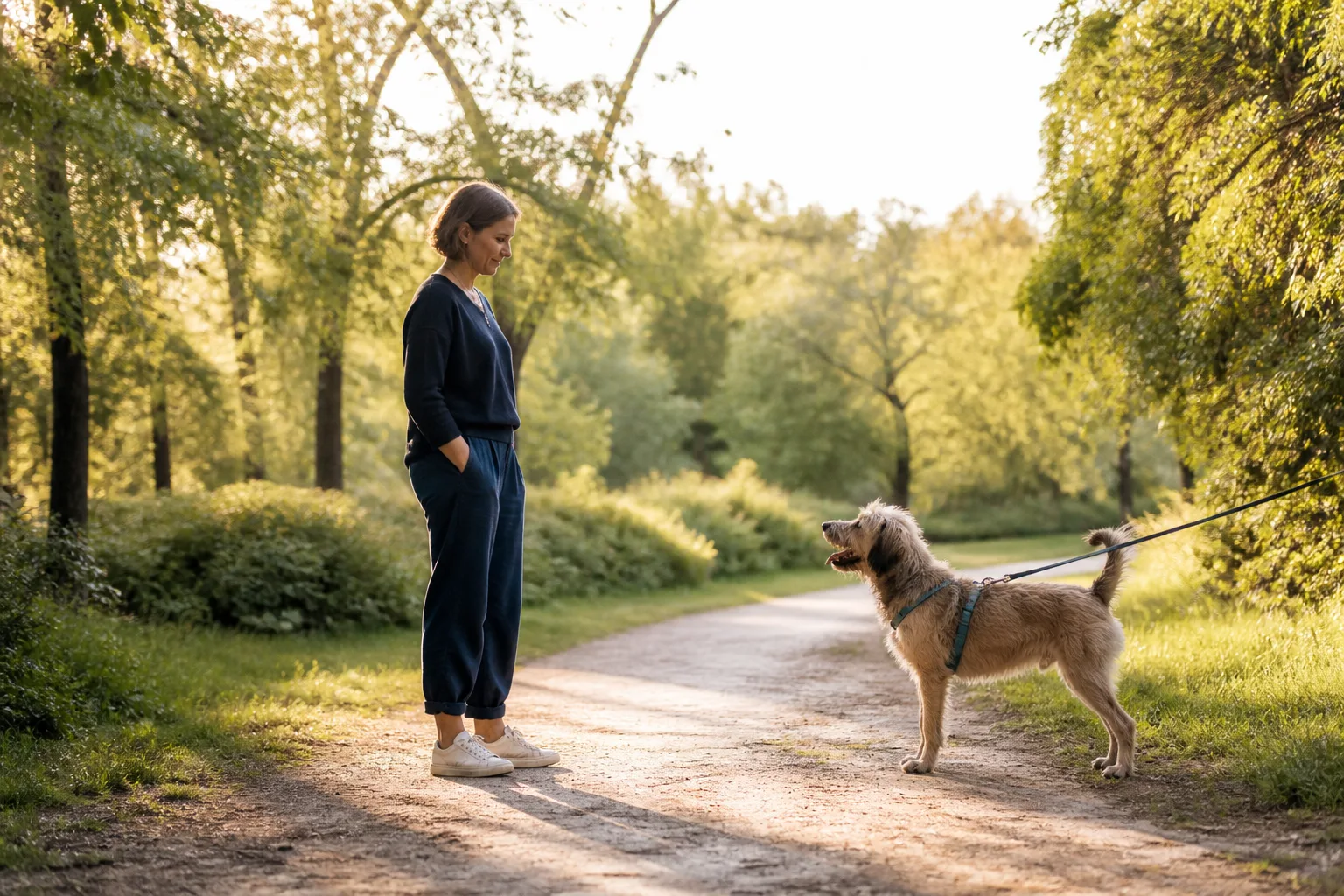
Understanding and resolving fear of dogs
A dog appears — leashed, calm, harmless — and still your pulse spikes, your hands go damp, and every instinct says cross the street. Cynophobia, often just called fear of dogs or dog phobia in everyday language, isn't a conscious decision. The alarm runs before your rational mind gets a say.
What neural processes trigger cynophobia during dog encounters?
With cynophobia, the amygdala reflexively switches to alarm and triggers flight or startle reactions at every dog encounter. Hypnotherapy calms that primal neural assessment, so encounters can be perceived matter-of-factly again.
The amygdala, a fast threat-detector in the brain, is behind it. It doesn't finely distinguish between a genuinely aggressive dog and a playful family dog on a leash — with cynophobia, it fires the same alarm for both: fight, flight, or freeze. Racing heart, sweating, the urge to run — all of it is a primal protective response that here simply fires too often and too hard.
How does the fear of dogs form in the unconscious, and what triggers it?
Fear of dogs develops either through an earlier trauma, such as a bite, or through fear patterns picked up from caregivers. In hypnosis, we work on that unconscious cause to resolve the internalised danger assessment.
For many, a specific incident is behind it — a bite, a jump-up, a single scary moment, sometimes as far back as childhood. For others, the fear crept in through childhood atmosphere: when parents or other caregivers themselves reacted fearfully to dogs, a child's unconscious mind often adopts that pattern directly, with no bad experience of their own required. And sometimes general stress or repeated startling is enough to anchor the fear — with no single, rememberable event at all. Many people affected can't even name the exact origin in hindsight.
Why isn't rational knowledge enough with fear of dogs, and how does hypnosis help?
Rational knowledge doesn't reach fear of dogs, because the amygdala responds to unconscious behavioural patterns rather than logical facts. Hypnosis resets that connection at the unconscious level, so rational calm actually arrives in the body.
Knowing that most dogs are harmless barely changes how the amygdala behaves. It doesn't respond to facts, only to an early-learned pattern. That's exactly why the fear often persists even though the conscious mind has long known there's no real danger — which is part of what makes it so frustrating for many: "I know nothing's going to happen — so why do I still react like this?"
How does hypnotherapy neutralise the unconscious alarm reaction during dog encounters?
In trance, the automatic "dog equals danger" link gets overwritten, in a protected setting, by experiencing safety and control. That lastingly dampens the physical fear reaction in everyday life.
In trance, we address the unconscious right where the "dog equals danger" link formed. We approach the topic of dogs purely mentally at first, at a pace you control, and re-file the old assessment. The goal isn't forcing yourself to stay calm — it's making the automatic alarm reaction itself quieter.
A client once told me she planned every walk in advance just to avoid running into a dog. After hypnosis, the first thing she mentioned wasn't a dog at all — it was that she could just head out spontaneously, without planning ahead.
How many hypnosis sessions does it take to overcome fear of dogs?
The length of therapy depends on how deep and entrenched the phobia is, but typically spans two to five sessions. A single shock experience is often processed faster than a fear pattern that's been internalised for decades.
The number of sessions depends less on dogs as a topic than on how deeply the fear is already anchored, and whether other issues are tangled up with it. With a single, clearly remembered trigger, it usually goes faster than with a fear that crept in over years.
How does hypnosis change your stance toward dogs for a more relaxed everyday life?
After treatment, the nervous system responds to dogs appropriately again, so walks become possible without constant scanning ahead and baseline tension. You regain trust in your own ability to assess and act.
Over time, it's not just the acute fear reaction that shifts — how you assess situations changes too: a dog barking in the distance goes back to being what it usually is — noise, not a threat. That more realistic assessment is, paradoxically, often more useful than pure fearlessness, because you notice real warning signs from an actually aggressive dog more clearly, instead of living in constant background tension.
Trust around dogs, in the end, is also about regaining trust in your own judgment — and that's exactly what trance can train, without you having to think of professional help as a last resort. Many people simply describe living with more ease afterwards.