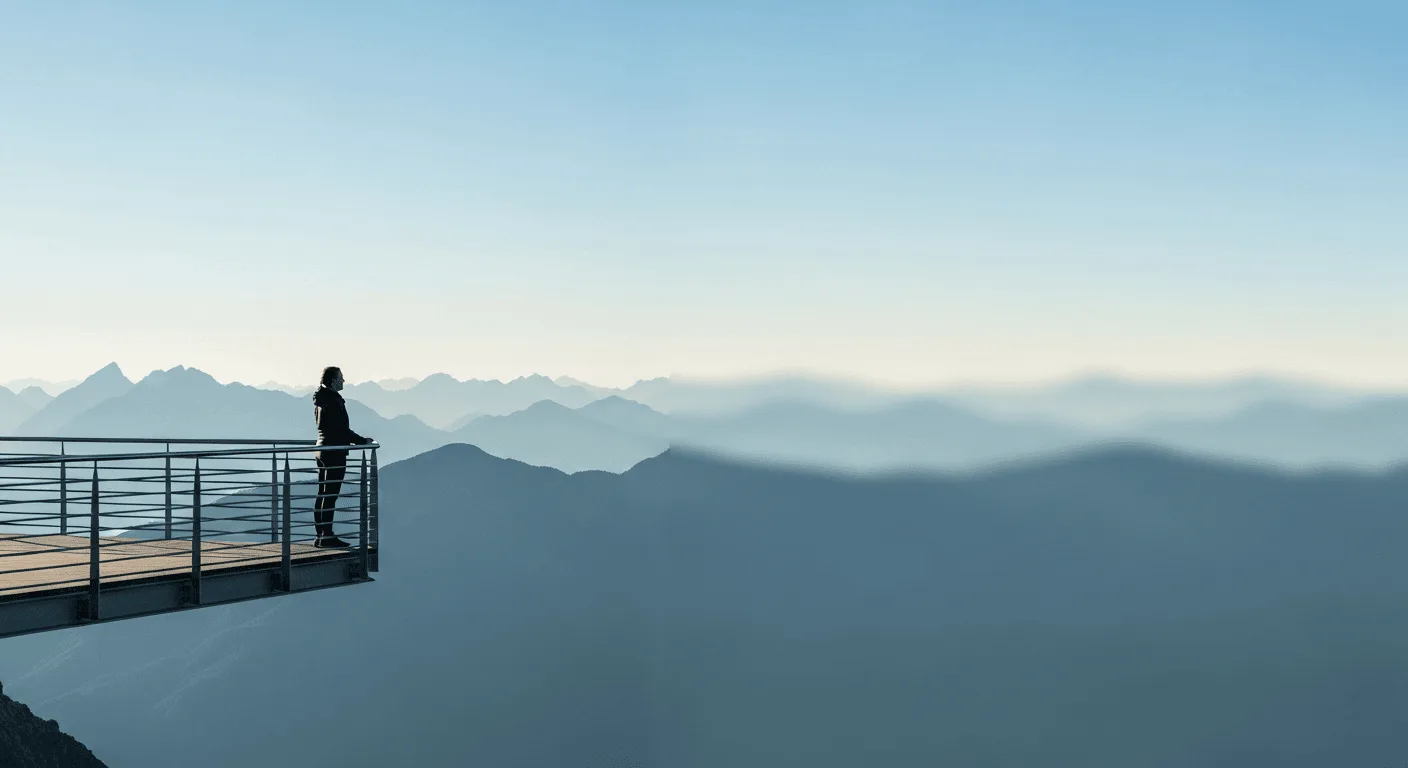
Overcoming fear of heights: what actually happens
Fear of heights ranges from a queasy feeling on a viewing platform to a full-blown panic attack on a ladder in the basement. What makes it so persistent isn't the height. It's the fact that you're basically right: something really could happen up there. Just not with the probability your body is currently reporting.
At what height do we call it acrophobia, and how does fear of heights show up?
Fear of heights (acrophobia) shows up as dizziness, weak knees, and a feeling of panic, even on balconies, bridges, or viewing towers. Hypnotherapy corrects the body's unconscious overreaction to height stimuli.
Almost everyone who comes to me for this has a surprisingly precise mark – a height where the feeling of safety tips into fear. For some that's a mountain ridge, for others the fourth rung of a ladder. Which is why "fear of heights" is actually a misleading name. It isn't about height, it's about a threshold. And thresholds can be moved.
How does real fear of heights differ from physiological height dizziness?
Physiological dizziness comes from the visual distance to the ground, while fear of heights is an emotional panic reaction to the change in elevation. In hypnosis, we treat the unconscious fear component.
This is the most important distinction with this issue, because it decides what we actually work on. Height dizziness is the queasy feeling when your eyes and your sense of body position disagree at height. Plenty of people know this, and it isn't a disorder – it's a completely normal reaction.
Fear of heights is what your unconscious makes of it: it files the feeling as danger and sounds the alarm. Racing heart, shaking, weak knees, nausea. So the work targets the reaction, not the dizziness.
Why is the unconscious fear of falling usually behind fear of heights?
Linking height to the image of falling reflexively triggers the brain's survival program. Through hypnosis, we decouple looking down from the catastrophic fantasy.
Almost nobody fears height itself. What's feared is the fall – and more precisely: losing control of yourself and falling because of it. That's why this fear sits so close to fear of flying and claustrophobia. All three circle the same moment, where you no longer have anything in your own hands.
How does fighting fear of heights make the symptoms worse at the edge?
Fighting fear of heights raises muscle tension and only makes the dizziness worse. In trance, you learn to let height stimuli happen calmly, which makes the panic ease immediately.
Once the fear is there, you grip tight, stiffen up, and consciously steer every step. That's the catch: your balance runs on fast, automatic corrections, and those work worse the moment your head tries to take over. For many people, footing actually does get less steady.
The fear supplies the proof it then cites. In trance, we strengthen the connection to the parts of you that handle walking anyway. Your legs keep going even when you're not actively steering them – they've been doing that for decades.
Why is suppressing fear of heights the wrong approach?
Simply suppressing it leads to tensing up and increases the urge to flee. Hypnotherapy gently transforms the fear pattern at the unconscious level.
An exaggerated fear is rarely nonsense. Usually it's protection that's overshooting, and protection is hard to fight. So the goal isn't to defeat the fear of heights, but to reset the danger detection to its natural setting. Queasy at the edge: yes. Panic on the balcony: no. That holds for every overcorrected fear, and for this one especially.
How does the mental climb in hypnosis train your footing at height?
In hypnosis, you mentally walk viewing points or mountains in absolute relaxation and safety. The brain carries that relief over into the real encounter with height.
The practical thing about hypnosis is that the climb doesn't have to happen outside. In trance, you go up the ladder, the stairs, the platform, right past the edge – while your body stays in the chair. Your unconscious takes in the experience anyway. The images that usually work against you run in the other direction for the first time.
And you can stop at any moment. That's exactly what the real balcony can't offer – in a fear that's all about control, of all things.
What's left at the end isn't indifference toward a drop. It's the difference between "I'll go carefully there" and "I won't go there at all."