
Jan Mion

Hypnotherapy for Nail Biting

Healthy nails – without fighting yourself.

You notice your hand at your mouth after it's already happened. Hypnosis works exactly where bitter polish and willpower stop working.

Book an appointmentOnline across Switzerland

5.05000+ Sessions · 11+ Years

Jan Mion, Hypnotherapist EZC
Jan Mion
Hypnotherapist EZC
Hypnosis works on the unconscious triggers behind nail biting – tension, stress, an automatic reflex – instead of just suppressing the action with bitter polish or willpower. Usually two to five sessions, online across Switzerland or in person in Zurich, resolve the pattern for good.
  • 2–5 Sessions typical
  • 60 min per session
  • No fight not against yourself
  • Online across Switzerland
How it works

How hypnosis works on nail biting

Nail biting almost never happens consciously. You're reading, watching a film, sitting in a meeting – and suddenly your hand is already at your mouth. That's no accident: your unconscious mind long ago picked biting as a quick way to release tension, nervousness or boredom. It means well by you, even if the result on your nails doesn't look like it.

That's exactly why willpower alone so rarely works. You can resolve a hundred times a day to keep your fingers away from your nails – the automatic pattern keeps running anyway, because it was never a conscious decision to begin with. Bitter-tasting polish and gloves fight the action; the decision behind it stays untouched.

In hypnotic trance we address the unconscious directly – where the automatic pattern formed. We find the triggers that are actually behind it for you, and replace the old reaction with a new one: the impulse becomes conscious enough that you notice it before your hand is already up, and the tension behind it gets a different outlet.

That's also why simply understanding the cause rarely does the trick. You can know exactly why you bite and still see no change in behaviour – understanding happens in the conscious mind, change happens in the unconscious.

Whatever your unconscious picked as an outlet, it can hand it back.

In detail

Understanding and resolving nail biting

Nail biting, medically onychophagia, is rarely a conscious decision. It happens while reading, watching TV, sitting in a meeting, waiting at a red light – your hand is at your mouth before you notice. That's exactly what makes it so persistent: you can't resist something you don't see coming.

What's happening unconsciously with nail biting

Your unconscious mind long ago picked biting as a quick way to release tension, nervousness or boredom. For some it starts as pure displacement activity – idle hands with nothing to do. For others there's a perfectionist thread: a small rough edge gets smoothed, then another, and smoothing turns into an automatic pattern that overshoots its original goal by a wide margin.

Neither is a character flaw. It's a strategy your unconscious found for itself because it worked in the short term – and has kept running ever since, without you ever actually agreeing to it.

Why bitter polish and resolutions alone rarely work

Bitter-tasting polish, artificial nails, gloves, or a firm resolution to "really stop this time" all target the same spot: the action itself. That can help briefly. But as long as the automatic pattern in the unconscious stays untouched, it's just waiting for an opening – the polish wears off, the resolution is forgotten two stressful weeks later.

What I notice again and again in practice: it's the moment right before a meeting or a date that ramps up the tension the most – and that's exactly where the automatic pattern strikes, no matter how firm the morning's resolution was.

How hypnosis resolves the automatic pattern

In hypnotic trance we work directly on the moment your hand moves toward your mouth. We find whatever tension, thought or situation is actually behind it for you – that differs from person to person, even when the outward behaviour looks the same. Then we install a new response there: the impulse becomes conscious enough that you notice it before your hand is already up, and the tension gets a different outlet than your nails.

Whatever your unconscious picked as an outlet, it can hand it back – that's the basic assumption I work from, and it holds up more often than you'd think on the first try.

When shame is part of it

For many people, the biting itself isn't the biggest problem – it's what grows around it: hiding your hands, the fear of being caught biting, the feeling that as an adult you should be "past this" already. That shame often fuels exactly the tension that leads to the next round of biting – a cycle that keeps itself running.

Working with the unconscious means addressing the cycle at both ends: the automatic pattern itself, and the shame that feeds it. People who tackle both usually notice the relief first – the nails grow back after.
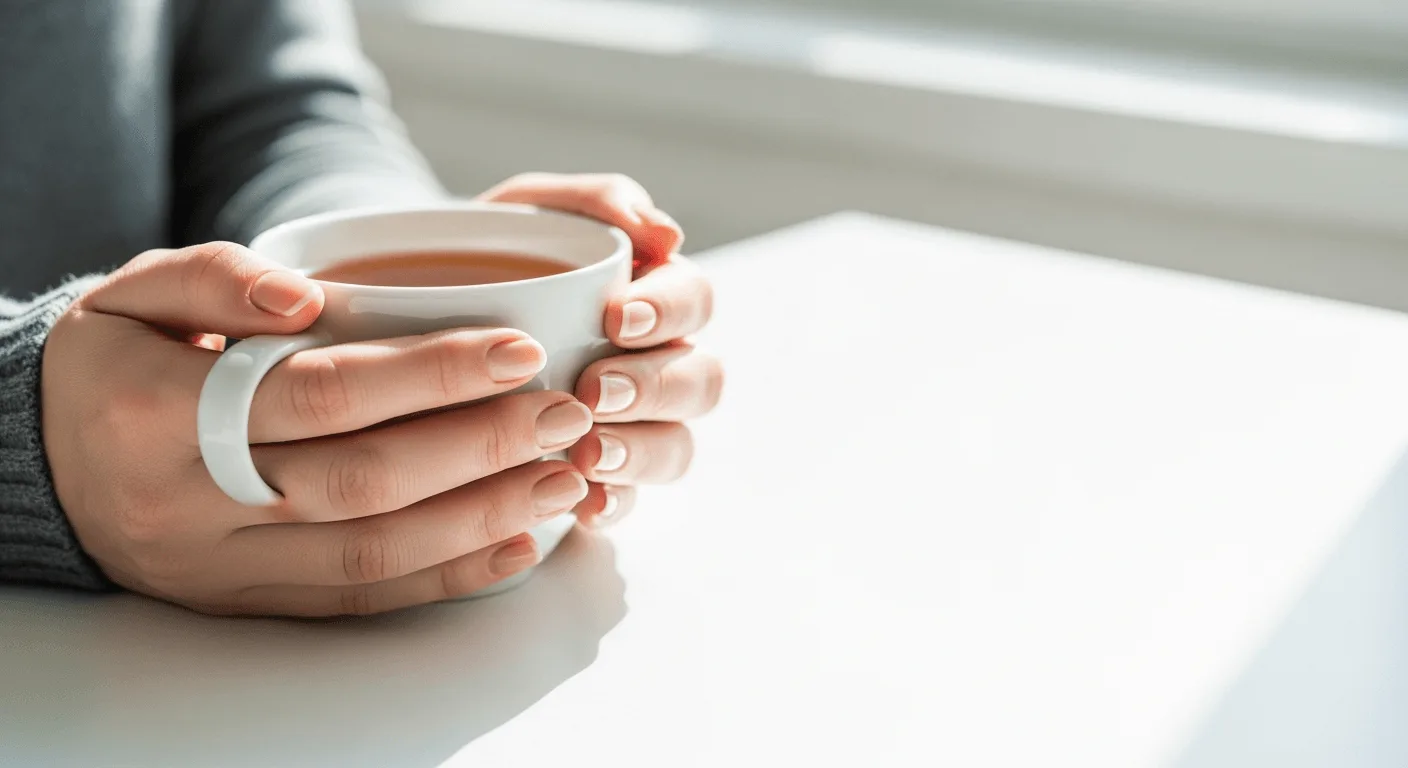
Hypnose gegen Nägelkauen (Onychophagie) – Tiefgreifende Lösungen finden
The change

What it feels like once nail biting is gone

Not having to hide your hands anymore. That's usually the part people notice first.

  • Show your hands without a second thought
  • The urge stays away, even under stress
  • Nails and cuticles get to grow back
  • No more daily fight against yourself
For whom

Who is this a good fit for?

Nail biting shows up very differently from person to person – from a habit since childhood to an automatic pattern that's fairly recent.

  • You've been biting for years or since childhood and never fully shook it.
  • Bitter polish, gloves or resolutions have helped at most briefly.
  • You often only notice your hand at your mouth once the nail is already gone.
  • You're ashamed of your hands and avoid showing them.

If you only nibble a nail occasionally and it doesn't really bother you, you don't need therapy for it – that's a quirk, not something to treat.

In a session

What happens in a session

Usually two to five sessions, booked individually – how many you need depends more on you than on nail biting itself.

  1. 01
    What I need to know
    We look together at when the urge to bite is strongest – which thoughts, which situations, since when. Not hypnosis yet, just a close look.
  2. 02
    The way into trance
    You get comfortable, and I guide you step by step into a calm, focused trance – similar to the state right before falling asleep, except you stay responsive the entire time.
  3. 03
    Working on the automatic pattern
    In trance we work on the exact moment your hand moves toward your mouth – we install a new response there, so the tension finds a different outlet than your nails.
  4. 04
    Coming back
    I bring you gently back to full alertness and we talk through what came up and what you'll now notice in everyday life.
Online or in person

Hypnotherapy for Nail Biting — online or in the practice

Nail biting often shows up in exactly the place you're already sitting – at your desk, in front of a screen, while reading. Online sessions meet you in that same environment.

Online via video

A quiet spot, a laptop and headphones are enough. Because you're in your own familiar surroundings – often exactly where the biting happens – many find the way into trance even easier this way.

More about online hypnotherapy

In person in Zurich

If you'd rather come in person, I see clients at two locations, Enge and Hottingen, both an easy transit ride away. For some, the deliberate change of scene away from their own desk helps.

Serious hypnosis

Serious hypnotherapy for nail biting

Two things I hear often – and what's actually true.

What people assume

Bitter polish or gloves solve the problem if you're just consistent enough.

Serious therapy

They interrupt the action from the outside. The automatic pattern behind it stays intact – which is why biting often comes back once the polish wears off.

What people assume

Nail biting is pure lack of willpower.

Serious therapy

Reaching for your mouth mostly runs unconsciously. You can't consciously control something that was never a conscious decision.

What people assume

In trance you lose control over your behaviour.

Serious therapy

Your awareness stays clear throughout the session – no blackout, and nothing happens without your consent.

What people assume

Hypnosis only works if you're easily influenced.

Serious therapy

It's the reverse – people who can concentrate well and picture things vividly tend to respond most strongly.

Will it work for me?

Yes — with nail biting, pace is the only open question.

Hypnosis works for practically everyone who engages with it. What differs isn't whether it helps, but the pace.

Where you land depends more on you than on nail biting itself — I've seen both with the same issue: the one session that changes everything, and the longer path where more was tangled up in it. Neither says anything about how strong-willed you are.

Fast progress
2–3 sessions

The pattern is still fairly recent or clearly tied to one specific situation.

  • Biting started as an adult
  • one clear trigger like exam stress
  • little shame around the topic otherwise
The typical case
3–4 sessions

The habit has been around longer and has linked itself to several situations.

  • Biting since your teens
  • several triggers at once
  • already tried a few things without lasting success
When it runs deeper
5 or more

Shame, self-worth, or a perfectionist smooth-it-out reflex are closely tangled with the biting.

  • Biting since childhood
  • strong shame about showing your hands
  • tied to self-worth issues

My honest promise: If I'm not convinced after the first session that hypnotherapy is really what's needed here, I'll say so to your face instead of just booking the next one.

Jan Mion – hypnotherapist
Your therapist

About Jan Mion

Jan Mion is a hypnotherapist from Zurich. What he keeps running into with nail biting: clients underestimate how much shame they carry for something that happens mostly unconsciously – as if it were a character flaw instead of a pattern they never consciously chose.

  • Hypnotherapist EZC
  • 1500+ hours of training
  • 5000+ individual sessions
  • In private practice since 2015

I've had clients who kept their hands in their pockets before an important meeting so no one would see their nails. After hypnosis, the first thing they mentioned wasn't their nails – it was that they could move their hands freely again.

Investment

Simple, fair pricing

Hypnotherapy session
CHF 200
per session, approx. 60 minutes

After the first session you'll know whether the urge is noticeably easing.

Good to know

Frequently asked questions about hypnosis for nail biting

Does hypnosis help with nail biting?

Yes. Hypnosis works on the unconscious triggers – tension, stress, an automatic reflex – instead of just suppressing the action. That's the difference from bitter polish or resolutions, which only work on the surface.

What actually helps against nail biting?

Bitter-tasting polish or artificial nails help short-term by making the action harder. Lasting change comes from working on the triggers behind it – which is exactly where hypnosis comes in, instead of just managing the symptom.

What does nail biting say about a person?

Not who you are – just where your unconscious mind is currently releasing tension. It's a widespread, well-studied behaviour pattern, not a character trait.

Is nail biting a psychological disorder?

It's classified as a body-focused repetitive behaviour (BFRB) and can, in pronounced form, be categorised alongside [obsessive-compulsive disorder](/en/hypnotherapy/ocd/). For most people, though, it stays a deeply automatic habit – no reason to worry, but a good reason to address the triggers.

Does hypnosis work even if I've bitten my nails since childhood?

Yes, especially then. The longer an automatic pattern has been practised, the deeper it sits in the unconscious – and that's exactly where hypnosis works, past the point conscious resolutions can reach.

How many sessions do I need to stop biting my nails?

Usually two to five. How many you need depends less on the nail biting itself and more on how long it's been established and what else is tangled up with it.

What do psychologists say about nail biting?

It's classified as a body-focused repetitive behaviour, triggered by stress, tension or boredom. This page focuses specifically on how hypnosis works with it.
Get started

Ready for the first step?

The first step is your first session. If it turns out afterwards that this isn't right for you, I'll tell you plainly instead of letting you keep going.

Book an appointment