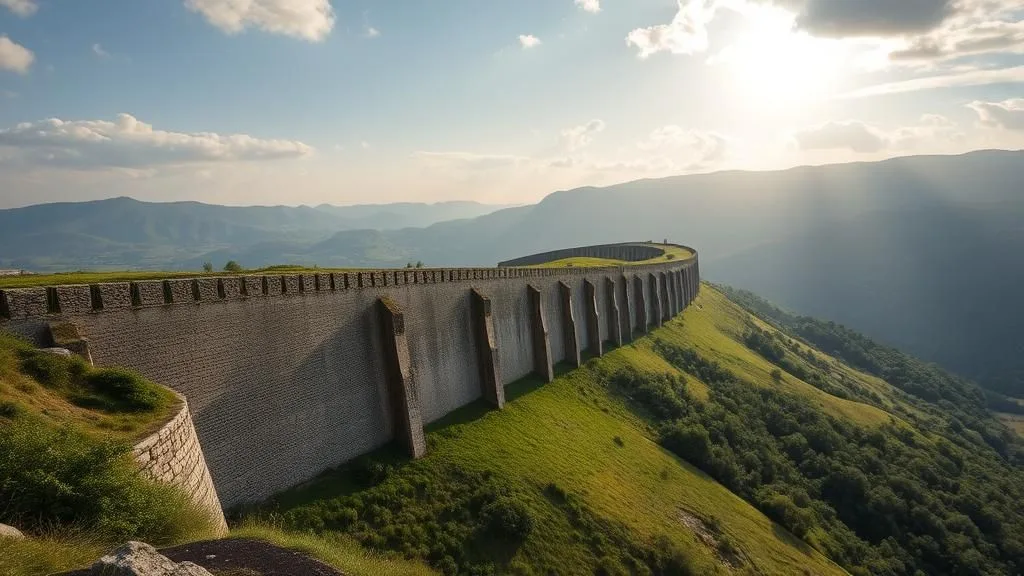
Clearly defined boundaries are one of the most important things, not just for mental health, but for life in general.
There’s a reason we say, “If you’re open to everything, you’re not quite watertight”—whoever doesn’t draw boundaries or respect them will, sooner or later, be caught up by their own nature.
Because by nature, all living beings draw boundaries quite naturally. If this doesn’t happen on its own, this natural function was disrupted somewhere. That means, however, that it is very well possible to learn how to set boundaries. And to do so without fear of rejection or anything similar.
Since nature handles the topic of boundaries very clearly, it makes the most sense to take examples from nature.
What are boundaries?
Boundaries are basically the transition from one thing to another. They can be clearly drawn or more fluid.
These lines help with differentiation and identification. So, for example, a cell is everything that is inside the cell membrane. Without this boundary, it would just be a bit of fluid.
In a psychological sense, this can be the dividing line between two emotions, or between yes and no. Here it becomes apparent: the clearer we draw these lines, the better and easier it becomes to deal with ourselves and the world.
In the context of mental well-being, the boundaries of the “I” and the boundaries of “mine” are especially important. For a wolf, that would be the boundary of its fur between its “I” and the outside, and the boundary between its territory and the rest of the world.
In social situations, setting clear boundaries is also important to sort out where we should spend our empathy and energy, and where staying away makes sense. Clearly following the motto, “We don’t have to like everyone, and vice versa.”
What belongs to me and what doesn’t, as well as what belongs to “mine,” are very important for optimal health. Ultimately, this also includes the most common type when it comes to drawing boundaries: what suits you and what you don’t want.
Types of boundaries
In our everyday lives, we need and will repeatedly encounter different types of boundaries. So it is also important to recognize them:
- Physical
- Emotional
- Mental
- Social
- Digital
- Familial
Depending on the type, the potential risks or even fears can be different when we want to assert ourselves and maintain those boundaries.
Why are boundaries important?
I assume that if you are reading this, you already know that boundaries are important. However, the extent of their importance is often not clear.
Clear demarcations help us not only to put our own well-being in the foreground, but also to respect that of others. People who are not yet so competent regarding boundaries also have a tendency to cross those of others without noticing it.
This can lead to rejection, aggression, and even bullying. This results from not noticing when you cross the tolerance threshold of others, when others react aggressively to it, but you also have no boundaries yourself and don’t defend yourself.
Own limits
But boundaries are not only important with others, but also with yourself, e.g., to focus our energy and time. Furthermore, they help with the clarity of feelings and relationships.
Additionally, self-respect is also linked to clear boundaries, for example with healthy eating (transition healthy/unhealthy, enough/too much), sports (transition passive/active), or going to bed early enough (transition awake/asleep).
If you have a clear outline of what you want, then it is much easier to achieve it and leave the rest out.
How can we set clear boundaries?
In my work as a therapist, I have seen certain patterns over and over again in people who had trouble drawing boundaries. Mostly, these are opinions learned from parents, especially in the area of commanded empathy or the rejection of natural aggression.
To enable natural boundary setting, the prerequisites must be in place. Whoever does not allow themselves to put their own well-being and that of their loved ones first will always find excuses for why they didn’t defend themselves just now. This is, as I said, mostly traced back to other people’s (especially parents’) boundaries. If those aren’t allowed to be incorrect, then it becomes hard to create your own boundaries.
Optimized
The steps for optimal demarcation involve the head and the heart, whereby the latter is clearly more important. Thinking “I should defend myself now” in your head is far less efficient than letting natural emotions handle it. But of course, here too: within boundaries, because overreactions are also a lack of healthy limitations.
3 steps to healthy boundaries
The natural process of drawing boundaries usually goes as follows:
Step 1: Feeling boundaries
The first important step takes place inwardly. Here, one question is especially important: “Does this feel right?”. This requires a certain mindfulness and often courage too, because feeling your own feelings often forces you to act.
Perceiving your own needs is thus an important first step to notice whether it is necessary to exert influence, but also to be clear with yourself and to be able to communicate clearly.
Furthermore, it is important that not all feelings need a logical justification. So, a “Doesn’t feel right” is enough to take the next step.
Step 2: Drawing boundaries
The next step is the clear communication of where the lines are drawn. This applies to others, as well as to yourself. If we feel that it doesn’t feel right, we should feel it intensely enough that it is noticeable to others. Whoever smiles when they suffer shouldn’t be surprised when others show no consideration for it.
So the communication begins on the inside, which then shows itself on the outside in looks, body language, and also aura.
Step 3: Defending boundaries
Boundaries without defense are a suggestion, and suggestions are mostly ignored. Of course, it is nice to think that everyone has a right, but the most important thing, as with all theories, is the implementation—in this case, demanding your right to boundaries.
That might be hard to read for some who like to please everyone or are afraid of confrontations.
But that’s also why it’s valuable, because it just isn’t always completely easy.
The defense of the limitations should stay within reason. The worst kind of defense is to bottle everything up inside and then explode. This is generally misunderstood and is very inefficient.
Here too, I have devised optimal steps from nature:
3a: Showing yourself
The wolf goes to the boundary when he notices that someone is approaching. In doing so, he looks and also shows himself. This already creates the initial understanding that someone is here.
3b. Showing teeth
If someone keeps going or approaches, despite the fact that you have shown yourself, then it is necessary to show the whole thing a bit more intensely. With our friend the wolf, that would be baring teeth and growling.
With humans too, a clear change in the atmosphere and facial expression is important. This can also be in the form of a smile, but one that has a certain aggression beneath the surface.
This kind of “saying no and meaning no” must be very clearly understandable to legitimize the possible next step. In doing so, we must be aware that we don’t just meet assholes who cross boundaries, but also idiots. To appropriately warn them of the consequences, the “stop” must be clear enough and understandable even for the most idiotic idiot.
3c. Exerting influence
If we have pointed out the limits clearly enough and they still keep going, then it is clear that our counterpart has the intention to cross the boundaries. This is where it comes into play that every living being has the natural permission to defend itself with whatever is necessary.
But even with the highest legitimation, it is important that it remains a defense and does not escalate into a counterattack. So, symbolically, the intruder is pushed back behind the boundary, but no further, upon which peace can then return.
The aggressive reaction can range from statements, questions, and insults, all the way to physical violence. Whatever is appropriate here, you have to allow yourself.
If it actually comes to this, it can also be very liberating. Because if you have clearly demarcated yourself and communicated it, then all people who keep going anyway can be classified as toxic or an “asshole” and let go. And this completely free of guilt.
Healthy and clear
With these steps, it is possible to set and defend optimized, clear boundaries. If we allow our inner selves to do so, then we will be very clearly supported in this by our unconscious, our inner nature.
So, the knowledge is good, but strong feelings are more important.
Hypnosis for drawing boundaries
The best way to thoroughly learn this skill is, in my opinion, hypnosis. Because during a natural boundary reaction, most of it happens unconsciously. So, many people also know what they should do, but still don’t do it.
In almost all cases, the unconscious is therefore inhibited or blocked in some way. If we now use hypnosis to release these blockages, then saying “no” becomes easier and also more effective, since there is more energy and power behind it.
We can also use the methods of hypnotherapy to dissolve the causes of boundlessness and replace them with healthy self-respect and self-worth.
With online hypnotherapy, the whole thing is even quite easily possible from home.
Conclusion
It is naturally innate to every human being to have, to draw, and to defend boundaries. In many cases, however, this is inhibited for various reasons. These inhibitions can be released, however, by allowing ourselves to put our own well-being in the foreground and letting our own nature take its course.
Methods like hypnosis can help make fundamental and lasting changes.